The P.I.G.
A Workshop For
Shopping the Plot In General
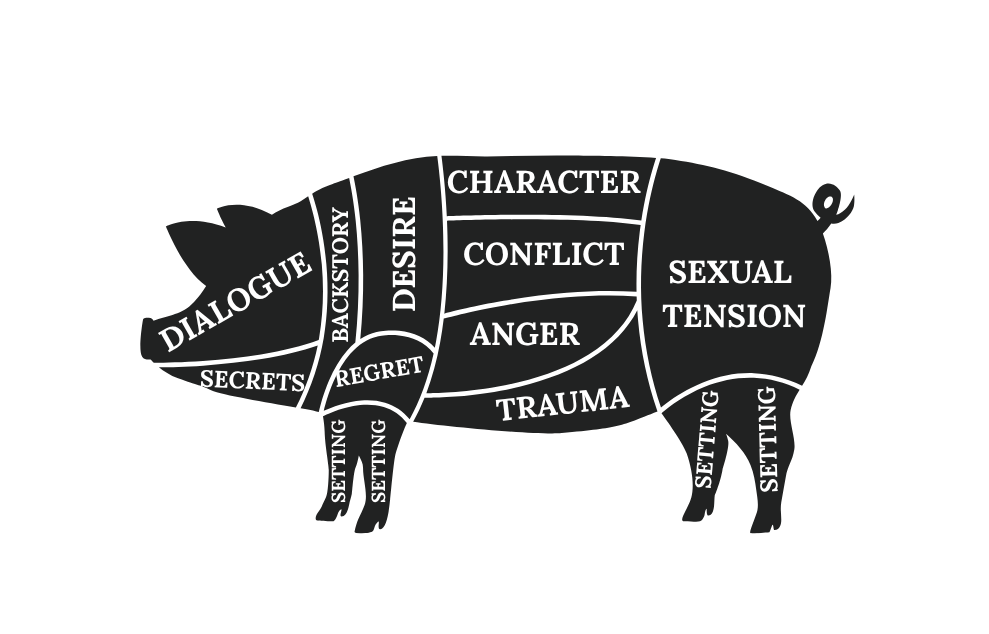
The P.I.G. is a practical, playful approach to turning the ordinary business of being alive into a pantry full of story possibilities.
It's a tool used to activate your imagination to constantly be on the lookout for inspiration in your everyday life, and collect the raw ingredients that can eventually become characters, conflicts, settings, and plot twists.
Before we fill the cart…
Let’s figure out what kind of shopper you are.
Are you the methodical sort? Do you go through the same door every time, grab your cart, and turn left to start at the produce, stick to the perimeter before working your way through the aisles, faithfully sticking to your list?
Or are you the person who gets the small cart because you’re sure you’ll stick to the list, but then you make a beeline for the candy aisle because there are too many people in the produce section, so you grab the good stuff, and then ricochet from aisle to aisle chasing whatever catches your eye? Ooh, shiny! What's that? Do I need it? Absolutely not. Into the cart it goes. (Totally me.)
In the literary world, you’ll hear the terms Plotter and Pantser. Neither approach is wrong or ‘better’. But understanding how you naturally explore the world can tell us a lot about how you gather story ideas, and how to make the most of your particular brand of creative chaos.
In the SHOP phase of the P.I.G., we'll explore:
People Watching: The characters all around you, from the woman arguing with her toddler to the guy wearing a three-piece suit at the laundromat.
Dialogue: The overheard snippets, peculiar turns of phrase, and conversations that make you wonder what happened before and what might happen next.
Setting: The places, textures, smells, sounds, and small details that make a fictional world feel real.
The Conflict Aisle: The friction, contradictions, frustrations, and unexpected complications that make stories move.
Weird & Random: Because sometimes the strangest things turn out to be the most interesting.
We'll experiment with following a plan and following an impulse, noticing what draws your attention and giving yourself permission to investigate the unexpected. You'll begin building a collection of story ingredients that reflects how you see the world.
No need to force a plot, outline a trilogy, or figure out your protagonist's tragic backstory while you're still standing in the produce section. While we’re SHOPPING, we’re just gathering ingredients to stock the pantry.
What You'll Take Home
You'll leave with more than a shopping list full of random observations and weird conversations (although you'll have those, too).
You'll have:
Your own Pocket P.I.G. A field guide where you can collect the people, places, dialogue, conflicts, and curious little details you encounter in everyday life.
A better understanding of your creative habits. Discover how you naturally gather ideas, where your attention wanders, and what happens when you step outside your usual patterns.
A toolkit for finding story material. Learn to recognize potential characters, settings, conflicts, and plot seeds hiding in plain sight.
Permission to follow the rabbit hole. Practice getting curious about the unexpected instead of dismissing it as a distraction. Sometimes the weirdest detours lead to the tastiest ideas.
A sustainable creative habit. Develop a practice of paying attention to the world around you, so you aren't always staring at a blank page waiting for inspiration to strike.
A pantry full of possibilities. Walk away with a growing collection of raw material you can return to whenever you're ready to start cooking up a story.
You don't need to leave with a plot. You don't need to know what any of your discoveries mean yet, after attending this workshop, you’ll leave with the beginnings of a practice that keeps your P.I.G. fed and happy!